
Harris County City Directory Runs
Houston is the key historical shelf for much of Harris County, but it is not the same jurisdiction as the whole county. The Houston Public Library genealogy material identifies a digitized Houston run from 1866 through 1924, partial coverage for 1925 through 1959, and physical directories through 1986. A directory title can carry Morrison & Fourmy, Houston city-directory, Polk-style city, or business-directory wording. Publisher labels and the exact run vary, so the title page of the volume is the reliable citation for a specific year.
| Collection | Years | Where Held | Access |
|---|---|---|---|
| Houston city directories | 1866-1924 digitized; physical run through 1986 | HPL Digital Archives and Houston Metropolitan Research Center | Free digital volumes where available; reference copies for the physical run |
| Houston directory coverage in HeritageQuest | Partial 1925-1959 | Clayton Library and HeritageQuest access | Licensed database or on-site library access |
| Houston Yellow Pages | Through 2005 | Houston Metropolitan Research Center | Reference or inquiry route; business and address continuity |
| Portal to Texas History city directories | 1850s-2020s statewide, item specific | UNT Libraries Portal | Free full-text, metadata, name, and page-image search |
There is no promise of a complete Houston volume for every date in the online sources. The partial middle run is a real gap, not a reason to substitute another date. For a Harris County address outside the City of Houston, check the postal city and legal municipality as well as Houston, then use the collection catalog to see whether the needed place is represented.
Note: Record the volume title, publication year, and page before treating an entry as evidence of a household or address.
Harris County Historical Directory Shelves
The Houston Public Library genealogy service joins Clayton Library Center for Genealogical Research with the Houston Metropolitan Research Center and Texas and Local History Room. Clayton is at 5300 Caroline Street in Houston and provides family-history material in books, microprint, and online formats with staff research guidance. HMRC holds Houston directories, local newspapers, maps, and city-history material. These collections are especially useful when a scanned volume is unavailable or its name index misses an entry.
The HPL Digital Archives are a practical starting point for the online Houston directory run.

Use the scan as a volume-specific source, then preserve its page reference along with the directory year. When the search result is thin, the physical holdings and library databases provide the next access route.
HMRC accepts limited directory inquiries by email at txr.reference@houstontx.gov. Its stated limits cover a small number of years and addresses per request and can change, so direct research at the library remains the better option for a long household trail. Library-card or on-site access may also be needed for licensed newspaper and genealogy databases.
Harris County Digitized Directory Volumes
The Portal to Texas History City Directories collection is broader than Houston, which makes its limits as important as its search tools. It contains city, business, legal, and phone directories from the nineteenth and twentieth centuries, with item-level indexes, advertising, names, addresses, and phone numbers. Search by full text, catalog metadata, title, subject, creator, or name. Guided, Advanced, and Proximity Search options, plus browsing by partner, decade, and resource type, help when a simple surname produces too many results.
The Portal’s city-directory collection gives a second digital path when an HPL scan is not the only relevant source.
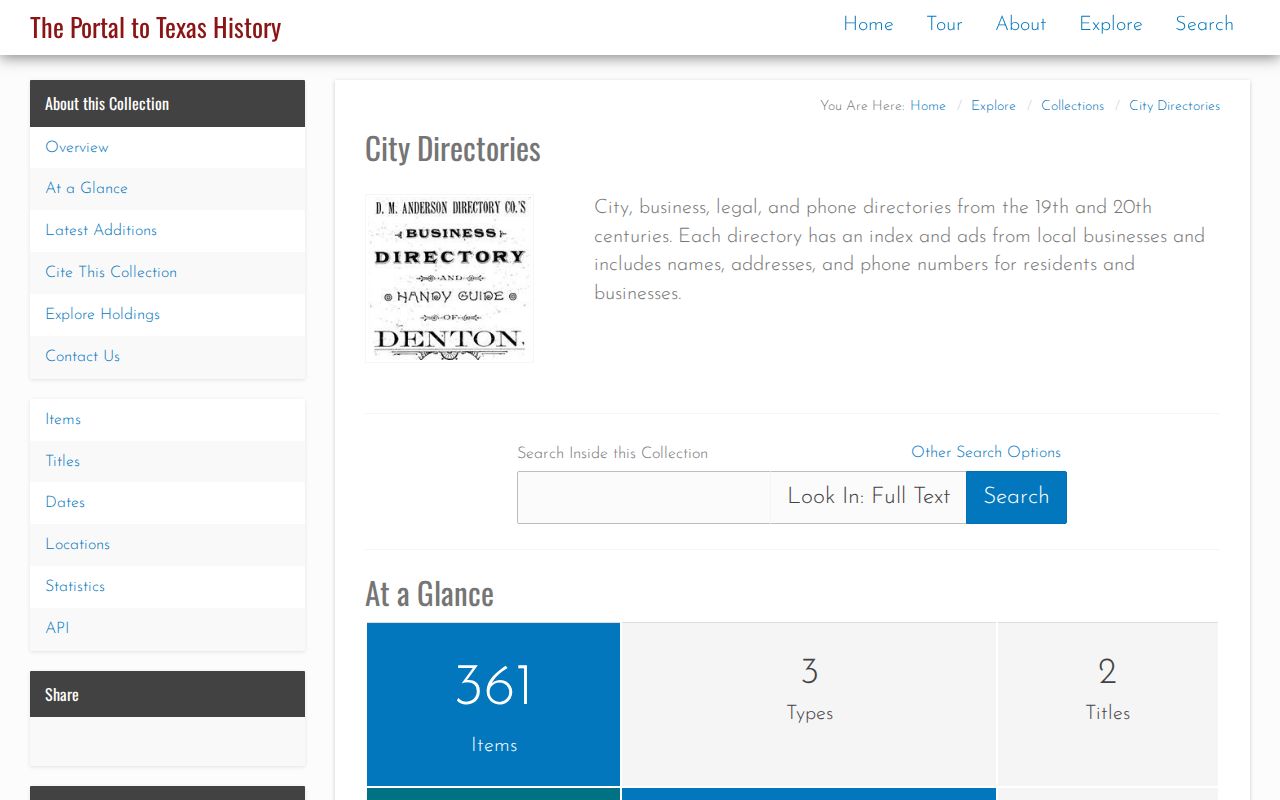
A statewide collection statistic does not establish Houston coverage for every decade. Open the item record, verify the city and year, and use the page image rather than assuming a search hit belongs to the right place.
Texas State Library and Archives guidance treats city directories as tools for people, businesses, and addresses, and points researchers to the nearest holding library. Its catalog and Ancestry Library Edition route are useful fallbacks where HPL’s online coverage is partial. Neither source turns an incomplete online run into a complete historical record.
Harris County Historical Directory Gaps
Partial online coverage from 1925 through 1959 needs a different approach. Check the adjacent directory years first, then ask whether Clayton, HMRC, HeritageQuest, or a Texas State Library route has the missing volume. A newspaper notice, obituary, map, or recorded deed can bridge a gap, but none should be silently relabeled as a directory entry. The HPL Chronicle archive covers 1901 through 2017 and the Houston Post archive covers 1880 through 1995, subject to library access conditions.
Preservation Houston’s research resources point researchers toward HPL directories, HPL Ancestry access, and related historical material for house and community work.
House-history material can help connect a modern address to its older form, but it is a research lead rather than a title determination. Compare a street spelling with maps, plats, and the directory’s own year before matching an address.
Decoding Harris County Directory Entries
Read an entry as a publisher’s snapshot, not a full census. A main alphabetical entry can give a surname, given name or initial, spouse notation, occupation, business or employer text, residence address, and sometimes a telephone exchange. Business entries can add a company name, proprietor or officer, a business address, and an advertising cross-reference. Some details vary by volume, so a missing field does not prove that the person was absent or that a fact was false.
| Name line | Surname plus a given name or initial; a spouse or widow notation may appear when supplied. |
|---|---|
| Occupation text | Work description and sometimes business or employer wording, subject to publisher abbreviations. |
| Residence | Street number and street name, with apartment, room, or boarding detail in some later volumes. |
| Telephone | A telephone number or exchange when the volume includes it. |
| Status notation | Some runs use owner or other status marks. Check that volume’s abbreviation key before assigning meaning. |
The title page, copyright or publication year, city boundary, and abbreviation key are part of the evidence. Photograph or transcribe the key before relying on shorthand. Later volumes may also contain a street-ordered section, but its presence and scope are volume specific.
- Criss-cross section
- A street-ordered portion of some directories that can place entries by numbered address rather than alphabetical name.
- Householder index
- An index arranged around the person or household named by the publisher, not a complete count of everyone at an address.
- Abbreviation key
- The front-matter explanation of the publisher’s shorthand. It controls how occupation, widow, residence, and other marks should be read.
Harris County Directory Address Sections
Reverse and criss-cross searching is the address-first complement to the alphabetical entry. When a volume has that section, it can identify the people listed at a numbered address. It cannot establish that every occupant was listed. The research method is to check both the person’s alphabetical line and the address section, then note any difference in spelling, number, or street name. HPL’s email service and HMRC’s physical run are local fallbacks when a digital image is not indexed.
Modern parcels use a separate chain of appraisal, GIS, and recorded-deed data. Once a historical address has been narrowed, the Harris County street directory supplies the present-day address-record path without replacing the historical volume.
Harris County Directory Timeline
The local run has a clear shelf history, even though a publisher-by-publisher sequence must be verified from individual title pages. The timeline below keeps the documented coverage dates separate from the larger statewide Portal collection.
| 1866 | Houston directories begin in the local collection. |
|---|---|
| 1866-1924 | Houston volumes are identified as digitized through the HPL digital archive. |
| 1925-1959 | HeritageQuest coverage is partial rather than a continuous online run. |
| Through 1986 | HMRC reports physical Houston city directories through this year. |
| Through 2005 | HMRC reports Houston Yellow Pages through this year. |
Those dates are collection coverage, not proof that a named person appears in a given issue. The title page and page citation remain the dependable way to document an entry.
Clayton’s Harris County Records Trail
Clayton Library is more than a place to look for a single surname. Its genealogy resources combine Houston directories with death-record transcripts from 1874 through 1900, Fogle-West funeral material, vertical files, family-Bible indexing, periodicals, and microprint. That mix is valuable when a directory disappearance could mean a move, a death, a new marriage, or simply a different listing practice. Houston’s rich newspaper and map holdings can then test the most likely explanation.
The African American Library at the Gregory School adds photographs, oral histories, and community material to Harris County historical work. Its holdings, Clayton’s genealogy resources, and HMRC’s maps and newspapers create a local trail that is broader than a directory alone. The Harris County Archives is another historical endpoint for permanent county records and private manuscript collections, with research by appointment through its 11525 Todd Street route. Treat each collection as evidence for its own date and purpose rather than merging them into one unverified narrative.
Note: A useful historical result has a volume, page, date, and collection name that another researcher can locate again.
Tracing Harris County Directory Volumes
Follow a household across several years to turn isolated names into a defensible chronology. Begin with the street spelling and legal address used in the year of interest. HCAD and county GIS can help resolve a modern address, while historic maps, subdivision plats, and Sanborn sheets help bridge older labels. Pair directory years with federal census years from 1870 through 1950, allowing for the census reference date and enumeration district. Compare names and occupation clues rather than treating either source as complete.
- Find the person or household in the directory year immediately before the target date and record the address, spouse clue, occupation text, and telephone detail if present.
- Check the year immediately after it. A changed street, surname variant, or new household member can identify a move or a changed listing practice.
- Use a reverse or criss-cross section when that volume includes one, and compare its numbered-address entry with the alphabetical result.
- Match the directory period to the closest available census, then compare household names, occupation, and enumeration geography.
- Use newspapers, obituaries, funeral records, probate, and recorded deeds to test an apparent move or death. Cite every volume and image separately.
A name vanishing from a volume has several possible causes. The person may have moved, died, changed a household listing, lived outside the covered city, or never been included by the publisher. A historical directory commonly omits some people, including transient boarders and rural residents. The next source should be chosen to test the particular gap, not to assume the reason.
Harris County Records Before Naturalization
For immigrant-family research, the Harris County District Clerk historic naturalization index has a defined local cutoff: 1837 through 1913. Later naturalization records move to federal or USCIS routes. This division matters when a directory entry names an address or occupation but does not answer when a person became a citizen. Search the right custodian for the period, and keep the directory citation separate from the court index result.
The Texas State Library and Archives Commission offers catalog, archive, and genealogy guidance that can help locate a holding library or broader research path.
State-level guidance is a fallback for incomplete local online runs. It does not replace the exact Houston volume, page, or local archive record needed to support a Harris County finding.